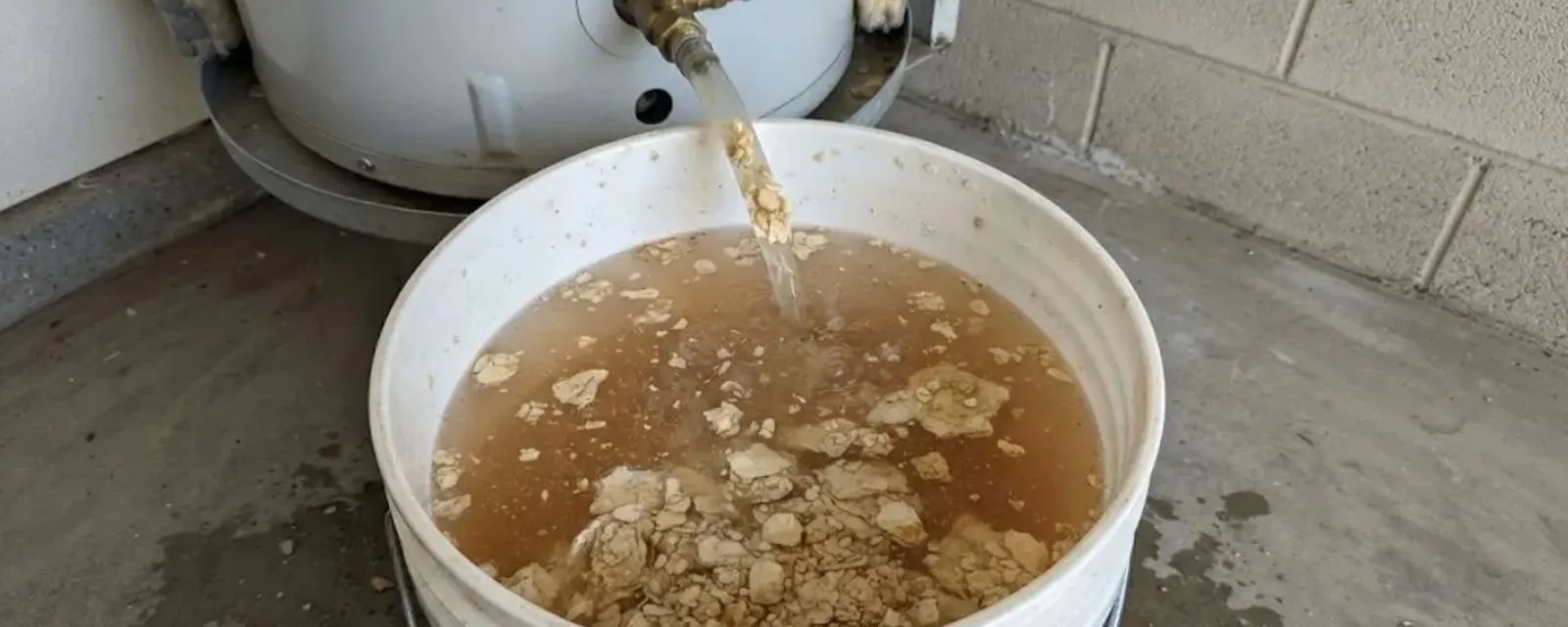
To flush a tank water heater, turn off power or gas, connect a hose to the drain valve, open a hot tap upstairs and let the tank empty into a floor drain or outside. Briefly open the cold supply to stir the bottom, then close the drain and refill. Plan on about an hour.
Do not force a drain valve that is stuck or leaking. If the tank is more than ten years old and has never been flushed, sediment may be packed hard. Call (805) 249-7135 before you start.
Why flushing matters more with hard water
Hard water carries dissolved calcium and magnesium. When water heats, some of it drops out as scale that settles in the bottom of the tank. On a gas heater, scale insulates the water from the burner and wastes fuel. On an electric heater, it coats the lower element and shortens its life.
- Popping or rumbling as the burner or element runs.
- Less hot water than the tank size would suggest.
- Gritty water or flakes at the hot taps after a service.
- A drain valve that clogs when you open it.
- A heater that takes longer to recover between showers.
The flush, step by step
Power off
Turn the gas control to pilot, or switch off the breaker for an electric unit.
Close the cold supply
Shut the valve above the heater.
Connect a hose
Attach a garden hose to the drain valve and run it outside or to a floor drain.
Open a hot tap
An upstairs hot faucet lets air in so the tank can drain.
Drain and stir
Open the drain valve. Once it slows, briefly open the cold supply to stir the sediment, then drain again.
Refill before power
Close the drain, fill the tank until hot taps run steady and only then restore power or gas.
Hot water from the drain can scald. Let the tank sit for an hour with the power off before you drain it.
Not comfortable flushing it?
Call and a plumber can flush and inspect your heater in one visit.
How often to flush
| Water type | Suggested flush | Why |
|---|---|---|
| Soft water | Every one to two years | Little scale forms |
| Moderately hard | Yearly | Steady sediment buildup |
| Very hard | Twice a year or yearly with a softener | Scale accumulates fast |
| Tankless heater | Descale yearly with isolation valves | Narrow passages scale up |
These are general guides. Your manual sets the manufacturer's recommendation, and a quick look at what comes out tells you the rest. A lot of gritty sediment means you should flush more often.
Lompoc local note: how hard is the water
The City of Lompoc's 2025 water quality report lists average hardness of 293 ppm, about 17 grains per gallon by simple conversion, with total dissolved solids near 817 ppm. The range across the ten wells was 245 to 318 ppm of hardness. By any standard, that is hard to very hard water.
That puts a Lompoc tank on the yearly or twice-yearly side. Customers in Miguelito Canyon served by the Frick Springs system have hardness near 405 ppm, so scale builds faster there. A softener shortens the whole story, and a well-braced heater is also a safety item. California Health and Safety Code section 19211 requires water heaters to be braced, anchored or strapped, so check the straps while you are there.
When a flush will not help
A flush removes loose sediment. It will not fix a tank that already leaks, a bad element or a failed thermostat. If the drain valve is plastic and cracks when you touch it, stop and call.
If the water comes out brown for a long time, if you see rust flakes or if the tank is over a decade old, the honest advice may be replacement. Our water heater repair page lists what we check, and water heater replacement covers the next step when the tank is done.
What comes out tells a story
| What you see | Likely meaning | What to do |
|---|---|---|
| Clear after a minute | Little sediment | Stay on schedule |
| White or tan flakes | Scale | Flush more often, consider a softener |
| Brown or rusty water | Tank corrosion or old pipes | Check the anode rod and tank age |
| Black grit | Anode or element debris | Inspect the rod and elements |
| Nothing flows | Packed sediment | Call a plumber |
Collect a cupful in a clear glass and look at it. Photos help if you later talk with a plumber or a manufacturer.
Gas and electric differences
On a gas heater, the burner sits under the tank, so a thick layer of scale makes the steel overheat and shortens the life of the tank. Rumbling is the classic sign. Flushing restores efficiency and quiets the noise.
On an electric heater, the lower element sits in the sediment and can burn out when buried. Flushing helps, and replacing a failed element is often cheaper than a new tank. Always switch off the breaker before draining, or the elements will burn out when exposed to air.
Safety points before you start
- Never drain a tank while the burner or element is on.
- Let the water cool for an hour or more.
- Use a hose that can handle hot water and aim it away from plants and pets.
- Open a hot tap before draining to avoid a vacuum.
- Wear shoes, since the floor can get wet.
If anything feels unsafe, stop. A plumber can finish the job in a short visit, and you will have a technician check the valve, the strap and the relief valve too.
Hard water habits that extend heater life
- Lower the thermostat to 120 degrees if the household allows it, since heat speeds scale.
- Check the anode rod every few years. A guide on that topic explains the steps in detail.
- Add a softener if hardness is high.
- Insulate hot water pipes within the first few feet.
- Keep the area around the heater clear for ventilation.
We service heaters across the Lompoc service area and in Santa Maria, where city groundwater is even harder.
Questions homeowners ask
Yes, with the power off and the tank cooled. Skip it if the valve is stuck or the tank leaks.
Sediment may be blocking the valve. Do not poke it with a screwdriver. Call a plumber.
It can, if the old drain valve is brittle. That is a sign it needed attention.
The city's 2025 report lists average hardness of 293 ppm, about 17 grains per gallon.
Tankless units are descaled with a pump and descaling solution through service valves.
California Health and Safety Code 19211 requires bracing, anchoring or strapping. Check yours.