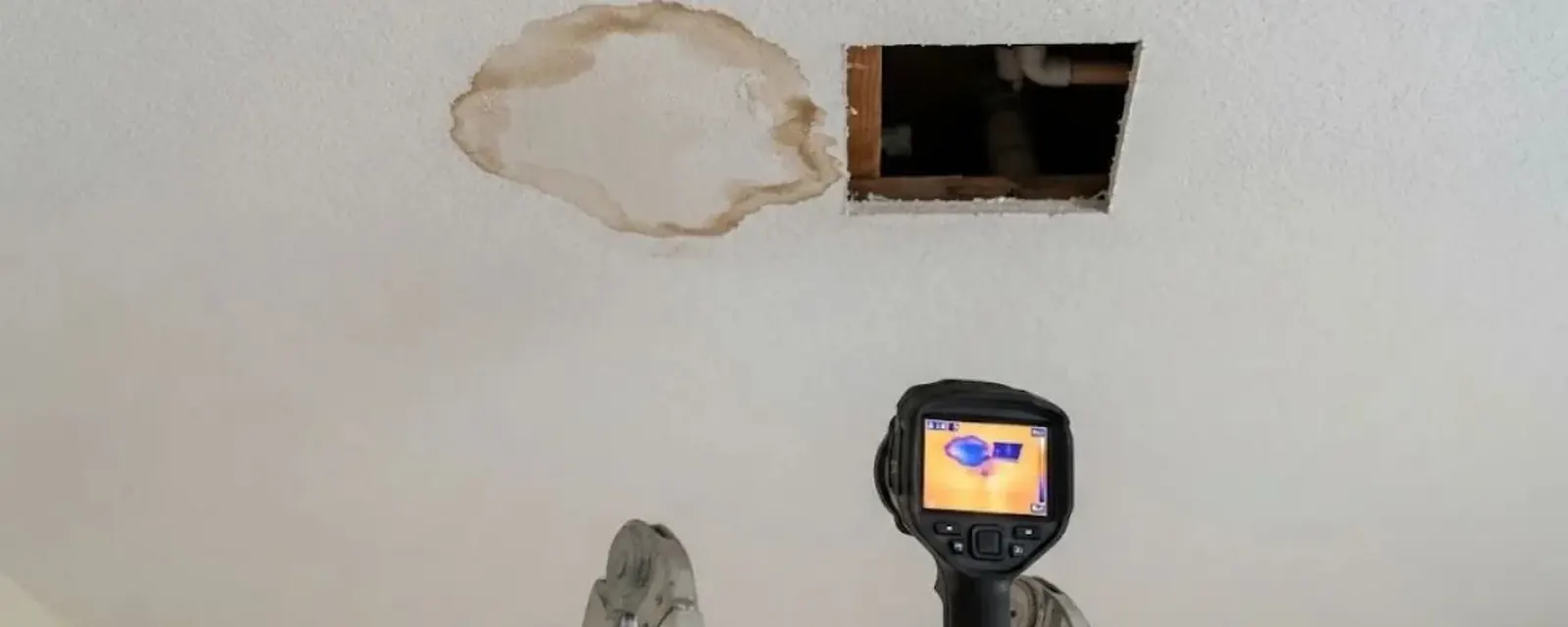
An infrared camera does not see water. It sees temperature differences on a surface. A leak under a floor or behind a wall can leave a cooler or warmer patch than the area around it, and the camera turns that into a color image. A trained plumber then confirms the cause with a moisture meter, a pressure test or acoustic listening.
If you have a high bill, a stain or a warm spot on the floor, call (805) 249-7135 and describe it. We will tell you whether a thermal survey makes sense or whether another method is faster.
What infrared can find
| Situation | What the camera shows | Reliability |
|---|---|---|
| Hot water line leak under a slab | A warm patch on the floor surface | Good, especially on tile or concrete |
| Wet drywall after a supply leak | A cooler irregular area | Good with a temperature difference |
| Roof or ceiling moisture | A cool zone around the stain | Moderate |
| Cold water line leak in soil | Hard to see | Low, use acoustic methods |
| Condensation or insulation gaps | Look like leaks | May fool the camera |
Thermal imaging works best when the leaking water is a different temperature from the surface around it. Hot water lines are the easiest case. A cold line in a cool wall can be nearly invisible.
Where infrared falls short
A camera cannot tell you whether a cool spot is a leak, a draft, an uninsulated stud or just shade. That is why thermal findings are checked against a moisture meter or a pressure test before anyone cuts into a wall.
It also cannot see through thick insulation or a concrete floor that is already evenly warm. On slabs, acoustic listening and zone isolation do the pinpointing. Our leak detection service uses thermal imaging as one tool among several for exactly that reason.
Think you have a hidden leak?
Call for a detection visit. Same-day appointments are offered when available.
The workflow we use
Interview
You describe the symptom, when it started and where it shows.
Meter test and isolation
We find whether the leak is on supply or drain, and which zone.
Thermal survey
The camera scans the suspect floors, walls and ceilings.
Confirm with another method
Moisture meter, acoustic equipment or a camera in the drain.
Report and options
You get the location and the repair choices before anything is opened.
Lompoc local note: fog, humidity and false alarms
Lompoc has a cool Mediterranean climate with common fog, about 15.4 inches of rain a year and mild temperatures. Humid mornings can cause condensation on cold pipes, windows and exterior walls, and condensation shows up as cool patches on thermal images.
That is why timing matters. We try to survey when the walls are dry and the indoor temperature is stable, and we repeat suspect readings. A cool wall stain that persists on a dry afternoon is more meaningful than one seen after a foggy morning.
For a meter test, a utility is typically responsible for its side of the meter and the owner for the house side, so ask the City of Lompoc how to confirm where a suspected leak sits.
What happens after the leak is located
Once the source is known, the repair depends on pipe type and location. A leak in an accessible wall is a patch and a pipe section. A leak under a finished slab may involve slab leak repair, with options from a spot repair to rerouting.
Keep photos of any damage for your insurer. Many policies cover resulting water damage and not the cost of finding the leak itself, so ask your insurer before you decide how to proceed.
Preparing the house for a thermal survey
- Turn the heat or cooling to a steady setting a few hours earlier.
- Move furniture away from suspect walls and floors if you can.
- Do not run the dishwasher or washer during the survey.
- Write down when you first noticed the symptom.
- Note any recent plumbing work in that area.
A stable indoor temperature gives a cleaner picture. Sudden changes, like sun hitting a wall or the heating cycling on, can create patterns that look like leaks. A short wait before the scan saves a lot of confusion.
Reading the report
A good report shows the thermal image and a normal photo of the same spot, labeled with the room and the reading. It lists the suspected source, the confirming test and the recommended next step. A report with only colorful images and no explanation is not much use.
Ask what the plumber ruled out. Condensation, missing insulation and sunlight are common false positives, and a careful operator will tell you how they excluded them. If the finding is weak, a second method such as acoustic listening or a pressure test is the right answer.
Keep the report with your home records. It helps with insurance claims, with future repairs and with the sale of the house.
Costs, time and what to expect
A thermal survey of a few rooms takes less than an hour. It often forms the first step of a larger detection visit that includes a meter test and pressure testing. We explain the price before work starts, and we tell you if a method will not help your situation.
Because findings need confirmation, a good visit ends with a clear next step. That may be a patch, a trap or pipe repair, a plan for opening a wall or a recommendation to keep watching. If nothing is found, we say so, and we suggest what to monitor.
Keep records of your water bills for the past year. A bill that climbed with no change in habits is evidence, and it speeds the diagnosis.
DIY thermal cameras: worth it?
Phone-attached thermal cameras are affordable and can help you notice a warm patch on the floor. They are not a replacement for a trained operator, because reading the image correctly takes experience. If you borrow one, use it to take pictures you can show your plumber, not to decide where to cut.
Our dispatch covers the whole service area, including Santa Maria.
Once a leak is located, replacement pipe follows the California Plumbing Code (Title 24, Part 5, 2025 edition, effective January 1, 2026), which is based on the Uniform Plumbing Code (UPC), and rerouting lines needs a City of Lompoc permit.
Questions homeowners ask
No. It works best for hot water lines and wet building materials. Other methods are needed for cold lines in soil.
Not before confirming the location. Thermal findings are checked with other tools first.
Yes. Condensation can look like a leak, so we repeat readings and confirm with a meter.
Shut off everything, read the meter and wait. If it moves, water is going somewhere on the house side. Ask the City of Lompoc how to confirm where its responsibility ends.
They can. We survey when walls are dry and repeat readings to rule out condensation.
Often the resulting damage is, and the detection cost may not be. Ask your insurer.