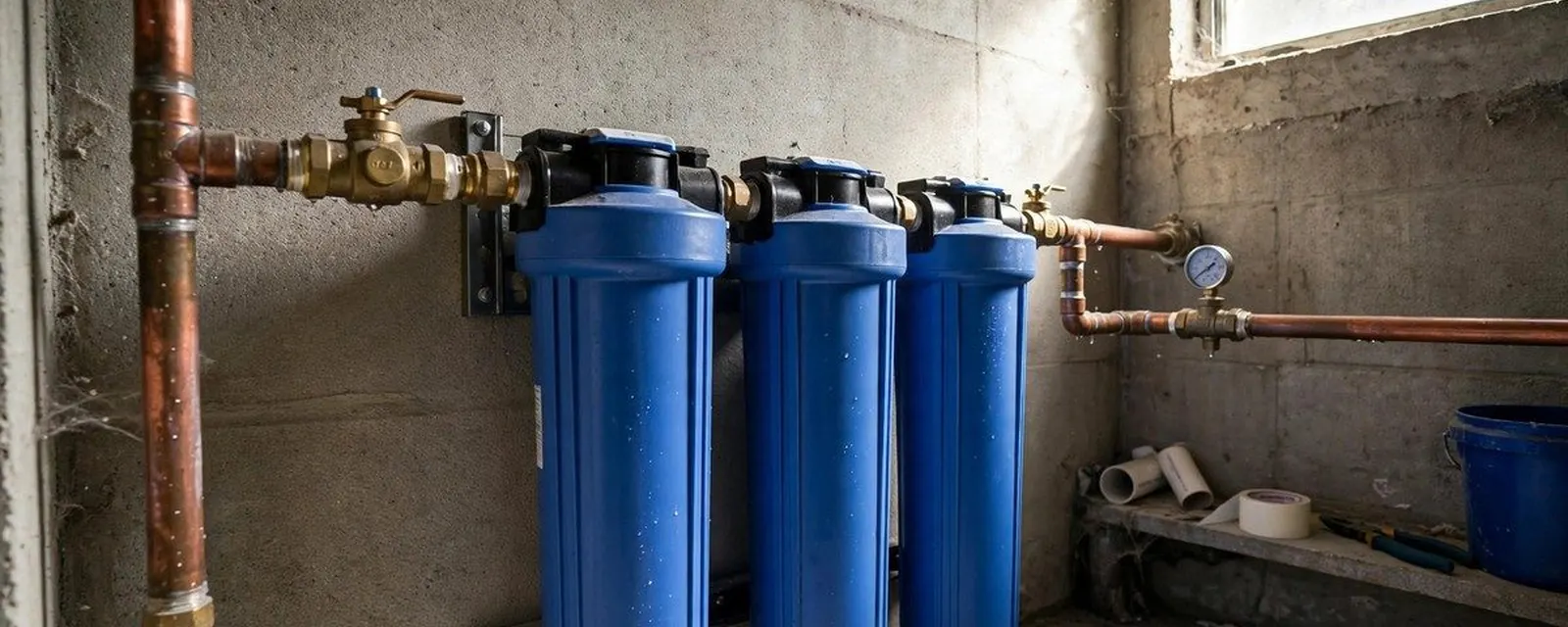
A laundry water filtration system treats only the water going to the washer. Depending on the product, it may reduce chlorine, sediment or hardness minerals. If your main problem is scale across the whole house, a softener is the stronger fix. If it is clothes and washer life, a laundry-side treatment can be a smaller step.
Lompoc's city water is hard, with the city's 2025 report listing an average near 293 ppm. Call (805) 249-7135 if you want a plumber to look at the washer supply and recommend something that fits.
What hard water does to laundry
- Clothes feel stiff, and whites turn dingy over time.
- Detergent seems to need more product for the same result.
- Scale forms on heating elements, seals and the drum.
- Soap scum builds on the washer door and detergent drawer.
- Washers wear out sooner than expected.
Minerals bind with detergent and form deposits in fabric. Using more soap makes the buildup worse, not better.
Your options, side by side
| Option | What it does | What it does not do |
|---|---|---|
| Sediment pre-filter | Catches sand and particles | Does not remove hardness |
| Carbon filter | Reduces chlorine taste and odor | Does not remove hardness |
| Scale conditioner (template assisted) | Changes how scale forms without removing minerals | Does not soften the water in the way a softener does |
| Salt-based softener on the washer line | Removes hardness | Needs salt, drain and power |
| Whole-house softener | Softens all water | Higher cost, adds a little sodium |
If you are already considering a whole-house system, our water softener and filtration page explains the choices.
Hard water hurting your washer?
Call for a recommendation matched to your home, not a one-size product.
Lompoc local note: what is actually in the water
The City of Lompoc's 2025 water quality report lists these averages for the city system: hardness 293 ppm, total dissolved solids 817 ppm, sodium 134 ppm and chlorine near 1.00 ppm. It lists the source as ten groundwater wells and says the water met United States EPA and California drinking water standards.
For laundry, hardness is the number that matters most. At about 17 grains per gallon, it falls in the very hard class of the US Geological Survey scale, which starts above 180 mg/L. Chlorine at 1 ppm can affect some fabrics and colors over time, which is where a carbon filter helps. Customers served by the Frick Springs system in Miguelito Canyon have water near 405 ppm, so a softener matters even more there.
How to size and install
A laundry-only system must match the washer's flow rate and the hot water demand. Washers draw a lot of water for short periods, and an undersized filter can starve them. Your plumber will check the supply valves, the pressure and the available space.
Test the water
A hardness test strip gives you a baseline.
Pick the target
Scale, chlorine or sediment, based on your issue.
Plan the location
Near the supply valves with drain access if needed.
Install with bypass
Shutoffs allow service without a leak.
Is it worth it for you?
If you have a newer washer and hard water, a laundry-side treatment can protect a significant purchase. If you also have a tank or tankless water heater, scale there may be costing you more than the washer. Treating all water at the entry point is usually the better path, and our tankless water heater page explains the hard water case.
For a new laundry hookup or washer box, see plumbing installation. We serve the whole service area and Santa Maria, where the city's groundwater is harder still.
Signs your washer is suffering
- White crust on the hose connections.
- Reduced water flow into the drum.
- Longer cycles because the heating element is scaled.
- A musty smell that returns after cleaning.
- Error codes related to the water inlet.
- Towels that feel rough even with fabric softener.
Inlet screens catch scale and sediment first. Pull the hoses and look at the screens. A clogged screen is an easy fix, and it tells you a lot about your water.
Cleaning a scaled washer
Run a hot cycle with a washer cleaner or a cup or two of white vinegar, unless the manufacturer says not to use it. Wipe the door seal and the detergent drawer by hand. Repeat every few months until the buildup stops returning.
If the machine is front loading, leave the door open after each load. If it is top loading, wipe the tub rim with a damp cloth. Use a measured amount of detergent, and add an extra rinse for heavy loads.
A water treatment system works best on a clean machine. Start with a deep clean, then install the filter or softener, and the results are clearer.
Putting it together for a typical laundry room
Most laundry rooms have two shutoff valves behind the washer and a drain box in the wall. A small filter or conditioner can be attached to the cold supply, with a bypass. A softener plumbed to the whole house removes the need for a separate unit.
Think about hot water too. Scale from hard water collects in the water heater, so the washer is only one place where the benefit shows up. A thorough plan treats the entry point, or at least the heater and the washer together.
If you rent, ask the owner before cutting into pipes. A removable point-of-use filter can be a compromise that you can take with you when you move.
Good laundry habits in hard water
- Use the detergent amount for hard water on the label, not extra.
- Run a washer cleaning cycle every few months to remove scale.
- Leave the door ajar between loads to dry the seal.
- Add a water conditioner only if the manufacturer allows it.
- Check hoses every few years and replace braided supply lines.
Questions homeowners ask
Only certain systems do. Sediment and carbon filters do not remove hardness.
Yes. It removes hardness before it reaches every appliance, including the washer.
It works differently. It changes how scale forms rather than removing minerals, and results vary.
The City of Lompoc's 2025 report lists average hardness near 293 ppm, about 17 grains per gallon.
The report lists hardness near 405 ppm for the Frick Springs system in Miguelito Canyon.
Yes. See our plumbing installation service.